A Fable About Refinancing

Open book with hand drawn landscape

Trevor- SP-Leadership-2016-Portraits-468

By Trevor Hammond

Diane walked into the house, setting down her things in the kitchen after a long day at work.  “Did you hear that rates have dropped?  Should we be looking into refinancing?”

Her husband Jack replied, “Yes, I did.  Some people at work have been talking about that for the past week.  But we just bought our house less than two years ago so it’s probably too soon.”

Diane thought about this.  She agreed that it hadn’t been very long since they got their mortgage, and their interest rate already seemed pretty low.  On the other hand, they had only put 10% down when they purchased the home so they were also paying monthly mortgage insurance.

Since they had purchased their first home, cash flow had been a bit tight, especially after their second child was born and Diane had cut back her hours at work to be with their two young children.  But she couldn’t help but wonder if the rise in home prices around them might also help them get rid of the mortgage insurance?

The following day, Diane decided to take the initiative and called her Mortgage Advisor, Trevor.  Trevor had helped them buy their house initially, and she at least knew that Trevor would tell her if it was crazy to be thinking about refinancing so soon.

By the end of the conversation, Diane had moved from skeptical, to relieved, to outright excited!  Not only did it seem that they had enough equity in their house to now get rid of the mortgage insurance, but it appeared that they would be able to reduce their interest rate by .5%.  Altogether, Trevor estimated that Jack and Diane would save just over $200 per month.

“But what about the closing costs?” Diane asked?

“Yes, there are some costs involved,” Trevor explained, “but here is a break-even analysis I’ve prepared for you.  With your monthly savings, in addition to having no payment due the first month after we close your new loan, you will break even on the costs in only eight months!  So, as long as you guys aren’t planning on moving before then, you can rest assured this is a smart financial move.”

“Now,” Trevor continued, “there is only one thing that can erode all of these great benefits of refinancing.”

“What’s that?” Diane asked, with a confused tone.

Trevor began to explain one of the biggest financial mistakes he had watched homeowners make over the years.  

“Too many homeowners refinance their home, lower their monthly payments, and free up cash flow they never had before.  Then, they have nothing to show for it years later.  The savings simply got absorbed into their spending habits.  My request is for you and Jack to decide where you will allocate the $200 each month that we are freeing up for you.  This is a tremendous opportunity to super-charge your kid’s college funds, boost your retirement contributions at work, or pay off that nagging student loan faster.  So will you commit to me that you’ll put this money to good use, and use this refinance as a catalyst for a better, safer financial future?”

Diane had never even thought about what a bigger role this refinance could play in helping to achieve the rest of their financial goals.  They were barely saving $200 per month now, and this would double what they could put away into savings!

Diane thanked Trevor for his advice and quick analysis and promised to complete the loan application and get the paperwork over to his team by tomorrow.  She couldn’t wait to share the good news with Jack.

What is the moral of the story?  Two incredible things are happening at the same time:  Rates are back down to all-time lows AND real estate values are up.  Many homeowners have never enjoyed this perfect combination for refinancing.  Take the time to reach out to your preferred Aspire Mortgage Advisor for a complimentary review of your current mortgage.  With good, honest advice and analysis, you will either walk away with peace of mind that you are already in the best position, or you will find a tremendous opportunity to improve your financial future.

Posted in Blind Spot 1: Developing a Plan, Uncategorized | Tagged , , , , , , , | Leave a comment

Stop Being Busy and Be Present

Be-Present

Trevor 2015

 By Trevor Hammond

If you are familiar with even some business development concepts, you may have heard people discuss the difference between being busy and being productive.  It can be described as doing lots of things versus doing fewer of the right things.

I’ve also heard it said that people who are constantly “busy” really are just pointing out their lack of organization and control over their time and priorities.  In fact, whenever people constantly tell me in an exasperated manner, “I can’t believe how busy I am!” I find myself just wanting to say, “then get organized!  You’re just telling me how unorganized and that you have no idea how to control your day and say “no” sometimes.”  I hate to sound like a grumpy old man, but it seems like people are constantly attempting to validate themselves by acting busy.  I have much respect for those who get so much accomplished with an air of peacefulness and confidence as they move through their days and weeks.

I have committed to becoming more and more productive for many years now.  At this point, I can’t stand the word “busy” and see no need for it unless we are describing a marketing piece with too much crammed into too little space.

But what about being “present”?  This is an interesting comparison I have recently been thinking about.

Here is one personal example.  One night each week my wife and I park ourselves on the couch to catch up on The Bachelor.  It’s mind-numbing, yes.  And I’ll admit it isn’t only her that enjoys it.  But regularly she will call me out on having my iPad open at the same time, catching up on Facebook or the latest news.  She gets frustrated when I can’t seem to just be “present” with her watching the show.  For some reason, I am keeping myself overly “busy” but I am missing an opportunity to be present.

Here is an annoying work example that we all can relate to.  How many times have you been sitting in a meeting with someone and they have their phone out on the table?  While you are attempting to engage in a conversation, the texts, alerts, and calls keep their phone buzzing throughout your lunch appointment.  Even worse, the person stops in mid-sentence to look down at the phone, gauge who the message is from, and then put it back down.  This is the essence of being so “busy” you can’t take the time to be “present” with the person you have blocked out time for.  And let’s be real – how often is this person I’m describing…you?

Looking back over the past week or so, how many times can you think of that you have not been fully present with your kids, your spouse, your friends, your employees, your team, your clients, etc.?

Consider that every time you or I check our phone while in a meeting, we are telling the other person that they are less important than whoever might be interrupting our conversation.

In this day of being constantly connected with our devices everywhere we go, it is up to us to make a conscious decision to be present with others.  Stop telling people how busy you are.  Think of ways you can be more productive, getting more of the right things done with less chaos and stress.  Say “no” to more things so you can say “yes” to the right things.

This isn’t easy for you or me, but I am committed to improving dramatically going forward!  How about you?

Posted in Uncategorized | Tagged , , , | Leave a comment

The 3 Reasons Budgets Fail (and How to Help Your Children Succeed)

Kids & BudgetEach month we will continue to dedicate an article to helping parents raise financially responsible children.  Here are links to some previous posts: ; Kids & Money – FAQ  and Kids & Money – What is Your Child’s Financial Personality Type

Nobody likes budgeting.  It ranks right up there with root canals, dieting and cleaning out gutters.  If we all had it our way, we’d have so much positive cash flow each month we wouldn’t need to have a budget.  But for most, this isn’t reality.

According to most financial experts, the three primary reasons budgets fail are:

  1. Lack of commitment and self-discipline
  2. Setting unrealistic goals
  3. A serious emergency (losing a job, divorce, illness) that destroys any set budget

As an adult, I’m sure you can relate to these all too well.  Reasons number one and two can be fixed.  The third reason can at least be minimized with substantial savings to protect your budget.  Your child is a newcomer to this, and we have an opportunity to help them be better than we ever were, and start earlier than we ever did.

Why is a Budget Important?

Your children must understand why a budget is so important, especially as they are learning the habits of saving.  Having a budget in place allows you to confidently and consistently pay for what you need and save up for what you want.  This is about the simplest way to think of the fundamental reason for why you should have a budget, and also to be able to explain it to your children.

Setting Financial Goals

What goals does your child have?  What financial goals do you want to encourage them to focus on?  For most families, there are three main “buckets” you would like your kids to think about:  spending, saving, and giving.  Goals they might have for spending would be activities in the near future with friends, such as going to the movies, birthday gift for a friend, or a new shirt.  “Saving” would be for more expensive, mid- and long-term items such as a summer camp your child wants to attend, a new bike, or even a car.  My 9-year old is now saving up for the latest American Girl doll which is over $100!  This will take weeks, given her $9 per week allowance (matches her age)…especially given the fact there will be other items along the way she needs money for.  My 5-year old son now saves for new Lego sets regularly with his $5 weekly allowance.

Action Plan:

  1. For now, set a time with your child to discuss what a budget is and why it is important. If you have one, even if you need to blow off the dust that has accumulated on it, share it with them.  Let them see how you use a budget to run the household, pay bills, save for vacations, and pay for all of the great things they get to enjoy.
  2. Then, discuss with them their financial goals. Create a list of things they want to save for, and what regular weekly expenses they must put into their own budget, such as lunch money, school field trips, treats at the store, or school supplies.
Posted in Blind Spot 2: Increasing Fiscal Literacy, Uncategorized | Tagged , , , , , , , , | Leave a comment

The Art of Money: The Three Options With Every Dollar

the-art-of-money-impressive-paper-money-colla-R-YRShqo

Trevor 2015

By Trevor Hammond

With every dollar you have, there are only three things you can do with it:

     1. Spend it

     2. Save it

     3. Pay down Debt with it

This applies to really any amount of money you might have, or will have.  What do YOU do with your money?  How do YOU make the important decision every day on whether you will spend your money, save it, or pay down debt with it?  What knowledge do you rely on to help ensure you are making the best decision each time so that you are on the right path to your financial goals?

As most statistics show, the average savings rate in America is dismal.  I usually see 2% of people’s income as the average.  This then means that 98% of people’s income goes to spending or paying down debt.  Given the fact that Americans typically have far more debt than they should, it goes to reason that the majority of money is allocated to spending.

There is nearly unlimited advice on what you should do with your money each month.  In general, you probably already know that you (and all of us) should be spending less and saving more.  Sounds simple, right?  Yeah, simple, but not always easy…

Action Step:  Take a little time to determine how much of your money goes toward each of the three options.  It helps to block out one hour and log in to your bank accounts online or look at your monthly statements over the last three months.

Look at how much you deposited, or brought in.  Then, review how much of your money went OUT in the form of spending, or paying down debt, or hopefully even into a separate savings account!  Also, count any money that went into your employer’s retirement fund that you contributed pre-tax from your paycheck…that counts for saving!

Once you have the totals for spending, saving, and paying down debt, convert them into a percentage.  For example, let’s say you bring home (deposited, after-tax income) $5,000 per month.  Then you determine that $2,200 goes out debt payments (mortgage, auto loan, credit cards); and you have $500 automatically transfer into a savings account each month as well.  The rest gets spent on discretionary and non-discretionary items (food, gas, insurance, gifts, utilities, etc.).  Here would be your results:

  • 44% of your money goes to pay down debt ($2,200 dived by $5,000)
  • 10% of your money goes to saving ($500 dived by $5,000)
  • 46% of your money is spent

How do the numbers feel when you see them?  How can you increase your savings and spend less?  Are there ways to better manage your debt to eventually be debt free of everything but the mortgage?

There is no right answer here…but awareness goes a long way to improving habits around what we do with our money each and every month!

Posted in Blind Spot 1: Developing a Plan, Blind Spot 3: Storing Money Efficiently, Uncategorized | Tagged , , , , , , , , , , , , , , , | Leave a comment

The 3-Legged Stool


Trevor 2015

By Trevor Hammond


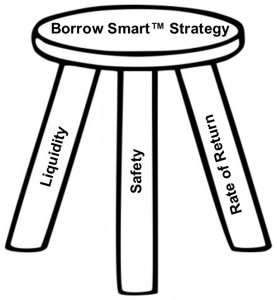
Whenever I am conducting a consultation with a new home buyer, I like to introduce what I call, the “3-Legged Stool”.  This becomes a crucial thinking tool for making smart home buying and investment decisions as it relates to your hard-earned money!

The three “legs” are:  Liquidity, Safety, and Rate of Return.  These are the three key filters for making all investment decisions, whether it’s what to do with $100 left over at the end of the month, or deciding between 10% versus 20% down payment to buy that new house.


Let’s start with liquidity.
  This means, how easily accessible is my money
when I put it somewhere?   We all understand that money in a savings or checking account is extremely “liquid”, meaning I could drive to the closest ATM machine and get some of it within minutes.  Money in a retirement account, on the other hand, is a bit harder to get to, thus there is less “liquidity”.  But how about money used for the down payment on a house?  How easy is it to get some of that money back out should you ever absolutely need it?  The short answer is, there are only two ways to access home equity – sell, or borrow (refinance or a home equity line of credit).  Either of these can take from two weeks up to two months, depending on your situation and the market.  Thus, it is critical for home buyers (and homeowners) to understand that equity in a home has the least amount of liquidity when compared to other investments.  So be smart when deciding how much to put do3-Legged Stool imagewn or when/if paying extra each month toward your mortgage payment.

Now, on to safety.  The second “leg” of the stool refers to, “How likely will my money be there when I need it?”  How safe is the equity in your home compared to other investments?  Equity is defined as the difference between how much you owe (mortgage) and how much your house is worth (purchase price).  While there are a number of ways you can lose the equity in your home that we discuss in our custom BorrowSMART Consultation™, the short answer is that home equity is considered pretty safe.  I often compare it to putting money into a long-term bond…not easily accessible but relatively safe.

3 Legged Stool DiagramFinally, the rate of return must be considered.  This refers to how much, or how little
interest you can expect to enjoy when investing your money somewhere.  While stocks tend to be considered riskier investments, people balance that risk with the likelihood of a better rate of return over time.  On the other hand, your checking or savings account offers a very low rate of return.  But what rate of return does the equity in your home provide?  To keep this letter brief…0%.  Equity in a home earns zero rate of return…forever.  By paying down a mortgage faster, or making a larger down payment, you do indeed SAVE interest.  Just keep in mind when you decide to “store” a lot of money inside your house in the form of “home equity”, that the only ongoing rate of return will be based on the value of your house.

I know this is brief and a high overview of our BorrowSMART™ strategies we help our clients with, but please reach out if you have questions or would like to learn more.  Our passion is helping homeowners, and new home buyers make smarter decisions when financing real estate.  We do this through a very unique process that helps you understand money at a higher level, and then apply this greater understanding to your important real estate financing decisions.  The result…a Bigger, Better Future™ for you and your family!

Posted in Blind Spot 1: Developing a Plan, Uncategorized | Tagged , , , , , , , , , , , , | Leave a comment

Did You Know that Appraisers are Monitored?

appraisal_form

Yost - biz pic

By Stacy Yost

Did you know that appraisers are monitored by FNMA?

Today, I’d like to highlight the plight of the appraisal world.  An appraisal is used to judge the property’s acceptability for the mortgage loan requested in view of its value and marketability.  As a lender we rely on appraisers to provide thorough, accurate, and objective appraisal reports that result in reliable opinions of market value so our underwriters can make prudent underwriting decisions.

FNMA keeps a database of home values, from which it regularly monitors appraisals from all areas. The way this monitoring system works, is that the Fannie program will flag potential errors in the appraiser’s evaluation before the lender commits to fund the loan. It will also score the appraisal for overall risk of inaccuracy. And finally, it can provide as many as 20 alternative comps.

If an appraisal comes across their desk that falls out of the home value parameters that has been set, it sends up a red flag and FNMA can decline to lend on that mortgage transaction, due to the excessive value of the appraisal.  As you all can guess, with our housing market on fire – and offers coming in well above asking price, some situations have arisen where FNMA has become the issue on the loan which can cause delays. However, using this information from Fannie, mortgage lenders like us will be able to question the appraiser or management company that hired the appraiser, and possibly demand changes to the initial appraisal.

This is where good communication with your lender is key.  Our team at Aspire Mortgage Group is here for you and will help every step of the way.


Posted in Blind Spot 1: Developing a Plan, Uncategorized | Tagged , , , , , | Leave a comment

What Was 2015 All About?

Growth & Innovation

Trevor 2015


By Trevor Hammond


What Was 2015 All About?

If you had to sum up your year, what words would you use to describe 2015?  And how will you use what you learned in 2015 to make 2016 even better?

For me, the first word would have to be “GROWTH”.  My mortgage company grew its business 200% in 2015, while we tripled the number of team members!  I had no choice but to also then grow as a leader.  In addition, I worked hard to grow as a father and a husband this year.

My second word would have to be “LETTING GO”.  Yes, I know this is two words but it’s the best way I can sum up this part of 2015.  I committed to taking more time off than ever before from business to travel and be with my family.  That meant I had to let go of the control of many things at work and trust others.  This isn’t easy when I set ridiculously high standards on myself and others around me!

“INNOVATION” would be a third word to help describe my year.  In building an exciting and unique mortgage company, I enjoyed rolling out many innovative tools and resources to our clients and internal team members.  I implemented new allowance rules for our two kids to help them begin learning about money and saving.  I launched new coaching workshops, wrote tons of new material for marketing, blogs, and two books I hope to release in 2016.

What words would YOU use to describe 2015 as you look back?  And how has 2015 set you up for an even better 2016?  What did you learn?  Knowing what you know now, what will you say “no” to in the New Year?

Posted in Blind Spot 1: Developing a Plan, Uncategorized | Tagged , , , , , | Leave a comment

2016 Is Your Year!

2016 New Year on heap of dollar bills. Business and financial concept.

Trevor 2015

By Trevor Hammond

Creating Your Best Money Year Ever in 2016.

One of the primary reasons many people do not achieve financial success is they have never stopped to define what it is that a “successful” financial picture looks like for them.  In order to achieve success in any area of life, you must first define what it looks like.  Otherwise, how will you ever know if you actually ever achieve success?

The path to achieving greater success with your money can be viewed in three critical steps:  Vision, Goals, and Habits.

2016 Best Money Year Diagram

The “M” stands for “Money”.  Your Vision is what financial success means to you.  This is where it all must start, and unfortunately this is the step that most people skip.  Most people start by writing down goals, yet fail to tie these goals to a bigger picture of what they want the end result (i.e. financial success) to look like.

Step 1:  To create your “M” Vision, answer this one question: 

“Imagine it is one year from today, January 2017.  Looking back over the past year, what must have happened with your personal finances for you to be happy with your progress?”

As you answer this question, remember you are looking back from the future.  Everything you say and write down has already happened!  So describe it in this way.  For example, don’t say, “I hope I have saved $5,000 in an emergency fund,” or “I want to pay off my credit card.”  Rather, “I have $5,000 saved in an emergency fund,” and “I have paid off my Visa.”

Step 2:  List your top three to five “M” Goals to accomplish in 2016

With your vision in place, it is now time to narrow down your focus to the specific action items.  Examples might include:

  • Put $250 per month into savings
  • Start a college savings plan for my kids with $200 per month
  • Pay off a car loan
  • Save up $10,000 for a down payment on a new home
  • Establish (and stick to) a monthly spending plan

Out of this list, try to choose the #1 goal that, if accomplished, will make the others easier or no longer necessary.  Typically one goal will be a catalyst to better accomplishing the others.  For example, paying off a car loan may free up $400 per month to then “super-charge” your savings goals.  Or, establishing a spending plan (a.k.a budget) might just be the necessary step to achieving any of the other goals.

Step 3:  Establish the two “M” Habits, or actions, necessary for you to accomplish the #1 goal

This is where the rubber meets the road.  What two habits, or actions, will you implement consistently to achieve this goal?  These must be very specific, and ideally you can put these habits into your calendar.  Depending on your specific goal you have chosen to tackle first, here are some examples:

  • Spend no more than $100 per week on groceries
  • Save 10% of my take-home pay each pay period into a separate savings account
  • Contribute 5% of my gross income to my 401k at work
  • Pay an additional $200 per month toward my car loan
  • Review and discuss our family spending plan for 30 minutes each Sunday evening

The first step to achieving a Bigger, Better Future™ for yourself and your family, is to go from “wishing” or “hoping”, to planning and execution.  Commit to your #1 goal and then have the courage to make the changes necessary to improve your financial life in 2016!

Posted in Blind Spot 1: Developing a Plan, Blind Spot 3: Storing Money Efficiently | Tagged , , , , , , , , , , | Leave a comment

What Books Will You Read in 2016?

Trevor 2015


by Trevor Hammond


For many years I have based personal and business decisions on this philosophy:

“Who you are ten years from now will be a result of the books you read and the people you spend time with.”

This quote is an adaptation of the one by Charles Tremendous Jones, and has been a guiding principle for me as I’ve worked hard to surround myself with the people who represent where I want to go (rather than where I’ve been).  But for this article’s purpose, let’s focus on the reading part of this philosophy.  And I don’t mean fun, fiction books!  (Though I enjoy them each night before going to sleep.)

My 2015 Reading Accomplishments

In 2015 I had big goals on reading a lot of books on personal and TH 2015 Accomplished readingbusiness growth.  As the visionary for my company and team, as well as a coach to many, a husband, a father, etc. reading great non-fiction books gives me the fuel to grow in all areas of my life.

As you can see in the picture, I made some great progress!

Interesting Statistics

  • 33% of High School Graduates never read another book the rest of their lives
  • 42% of college grads never read another book after college
  • 80% of U.S. families did not buy or read a book last year

In addition, according to Grant Cardone in his book, “The 10x Rule”, the most successful CEOs are reported to read an average of 60 books per year…whereas the average American worker reads an average of less than one book and makes 319 times less income.

My books for 2016

TH 2016 Reading GoalNow looking ahead to 2016, I have chosen key books that I hope will continue to play a big role in my continued growth and leadership capabilities.  One of my rules is to only choose books that have come highly recommended.

What books will YOU read in 2016?  When will you block out time in your days to work on your own personal growth by reading?  I would love to hear!

Posted in Leadership, Uncategorized | Tagged , , , , , | Leave a comment

Pressure for Perfection

three-stooges-turkey-edit-use

mary

by Mary Murphy

Christmas is the time of year when the pressure to be perfect intensifies. We imagine the perfect celebration and then put forth our best effort to make it happen. We shop for the perfect gifts. We plan the perfect Christmas Day meal. We choose the perfect greeting cards or write the perfect family letter. But our striving leads to discouragement and disappointment when our ability to imagine perfection exceeds our ability to implement it. The carefully chosen gift receives only a half-hearted thank you. Part of the meal is overcooked. We find a typo in our Christmas greeting after we’ve mailed the cards. Children fight over toys. Adults resurrect old arguments.

Instead of being discouraged, however, we can use our disappointment to remind ourselves of the reason Christmas is so important. How much more meaningful would our celebrations be if we would give up our faulty concept of perfection?

If your Christmas celebration this year is less than ideal, relax, there is always next year!


Posted in Uncategorized | Leave a comment